
THE Human resources position is vital to the successful operation of a business. Human Resources Management involves the development of a perfect blend between the core HR operations that keep a business running day-to-day and the well-being of all employees within the organisation. Employee retention ratio is directly proportionate to the manner in which the employees are treated, in return for their imparted skills and experience. A Human Resource Manager ideally empowers interdepartmental employee relationships and nurtures scope for down-the-rung employee communication at various levels. The field is a derivative of systems theory and organisational psychology.
Human Resources has earned a number of related interpretations over time, but continues to defend the need to ensure employee wellbeing. Every organisation now has an exclusive human resources management department to interact with representatives of all factors of production. The department is responsible for the development and application of ongoing research on strategic advances while hiring, terminating, and training staff. Human Resources Management is an important asset to any business. It provides for managing change and facilitating training and development, recruitment, selection, employee relations, pensions and benefits, and communicating with employees.
What an HR Manager Is Responsible For
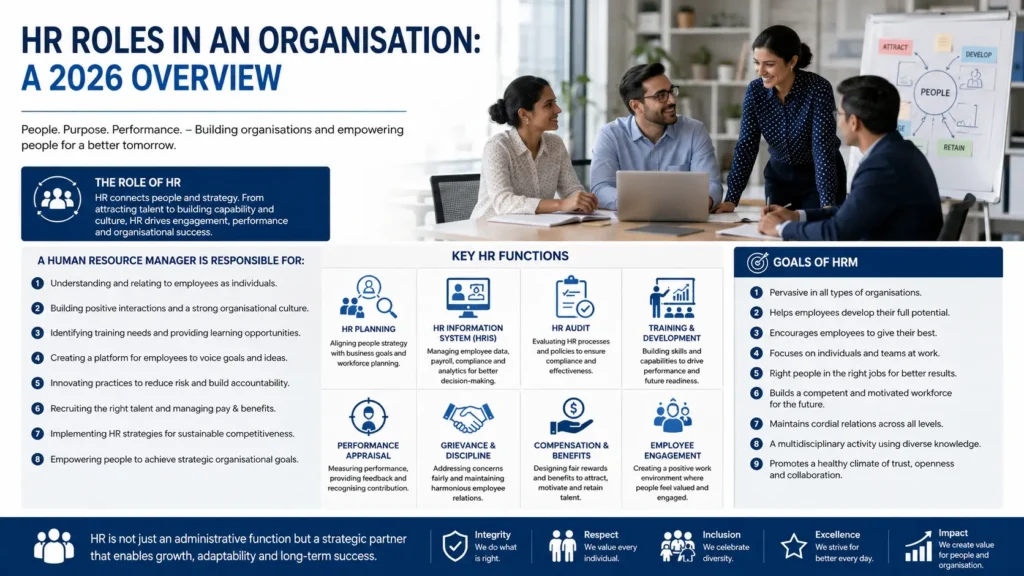
The HR generalist role spans the entire employee lifecycle. In practice, a Human Resource Manager is responsible for:
- Understanding and relating to employees as individuals, thus identifying individual needs and career goals.
- Developing positive interactions between workers to ensure collective and constructive enterprise productivity and development of a uniform organizational culture.
- Identify areas that suffer from a lack of knowledge and insufficient training and accordingly provide remedial measures in the form of workshops and seminars.
- Generate a rostrum for all employees to express their goals and provide the necessary resources to accomplish professional and personal agendas, essentially in that order.
- Innovate new operating practices to minimize risk and generate an overall sense of belonging and accountability.
- Recruiting the required workforce and making provisions for the payroll and benefits administration promised at the point of hire.
- Implementing resource strategies to subsequently create and sustain competitive advantage.
- Empowerment of the organisation to successfully meet strategic goals by managing staff effectively.
A Human Resource Manager is responsible for an interdisciplinary examination of all staff members in the workplace. This strategy calls for applications from diverse fields such as psychology, paralegal studies, industrial engineering, sociology, and a critical understanding of theories pertaining to post-modernism and industrial structuralism. The department bears the onus of converting the available task force or hired individuals into strategic business partners.
This is achieved via dedicated change management and focused employee administration. The HR roles have the sole goal of motivating and encouraging the employees to prove their mettle and add value to the company. This is achieved via various management processes like workforce planning and recruitment, induction and orientation of hired task force and employee training, administration, and appraisals. The Human Resource Management roles include a variety of activities, and key among them is responsibility for human resources for deciding what staffing needs you have and whether to use independent contractors or hire employees to fill these needs, recruiting and training the best employees, ensuring they are high performers, dealing with performance issues, and ensuring your personnel and management practices conform to various regulations. Activities also include managing your approach to employee benefits and compensation, employee records, and personnel policies.
AN HR manager’s role is to maintain adequate staffing levels for a business and to fill each position with the applicant who is most qualified to perform the job successfully. To do this, an hr manager may post job openings, test applicants, conduct or schedule interviews, and attend recruiting events.
Human resources management is a process of bringing people and organisations together so that the goals of each are met. The various goals of HRM include:
- It is pervasive in nature as it is present in all enterprises.
- It tries to help employees develop their potential fully.
- It encourages employees to give their best to the organisation.
- It is all about people at work, both as individuals and groups.
- It tries to put people in assigned jobs in order to produce good results.
- It helps an organisation meet its goals in the future by providing for competent and well-motivated employees.
- It tries to build and maintain cordial relations between people working at various levels in the organisation.
- It is a multidisciplinary activity, utilizing knowledge inputs drawn from psychology, economics, etc.
- A healthy climate with values of openness, enthusiasm, trust, mutuality and collaboration is essential for development.
The Human Resource (HR) Manager position is vital to the successful operation of a business. These managers perform such tasks as hiring, training, and maintaining a healthy workplace environment. The right number of people with the right skills in the right place at the right time to implement organisational strategies in order to achieve organisational objectives:
- Human Resources Planning (HRP): The HR manager must understand the business requirements. Only if he comprehends the nature and scope of the business will he be able to employ those who will deliver the required performance. When it comes to engaging the manpower, the manager should have a keen eye for spotting the talent. It ensures that the workforce is competent enough to meet the targets.
Additionally, the existing ‘talent pool’ in the workplace should be taken into consideration, so that people with complementary skills can be employed. The functions of the hr manager are varied; he has to assess the currently employed workforce and their shortcomings. Identifying these shortcomings goes a long way in choosing an efficient workforce. Recruitment and selection begin long before a vacancy is advertised: while recruiting new employees, the HR manager must first calculate the expected workload. This way, the HR department can design an accurate job profile and job expectations. Once you have the decided job descriptions, looking for candidates who fit the job will be easy. Don’t be fooled by their qualifications; it is only the relevant experience that matters more. A good HR manager is one who has the zeal and passion to motivate his prospective employees to perform to their potential. The human resources planning process, thus, can be considered as one of the strategic steps for building the strong foundation of an efficient workforce in an organisation:
- Interfacing with strategic planning and scanning the environment.
- Taking an inventory of the company’s current human resources.
- Forecasting demand for human resources.
- Forecasting the supply of HR from within the organisation and in the external labour market.
- Comparing forecasts of demand and supply.
- Planning the actions needed to deal with anticipated shortages or overages.
- Feeding back such information into the strategic planning process.
The manpower planning approach which addresses questions such as:
- How many staff do we have/need?
- How are they distributed?
- What is the age profile?
- How many will leave in each of the next five years?
- How many will be required in one, five, ten years?
- Human Resource Information System (HRIS): The Human Resources Information System is a software or online solution for the data entry, data tracking, and data information needs of Human Resources, payroll management, and accounting functions within a business. An effective HRIS provides information on just about anything the company needs to track and analyse about employees, former employees, and applicants. In most mid-sized and large organisations, this runs on enterprise platforms, which is why working knowledge of HRIS platforms like SAP HCM has become a baseline expectation for HR executives. A better HRIS provides overall:
- Management of all employee information.
- Reporting and analysing employee data to support workforce decisions.
- Company-related documents such as employee handbooks, emergency evacuation procedures, and safety guidelines.
- Benefits administration, including enrolment, status changes, and personal information updating.
- Applicant tracking and resume management.
- Complete integration with payroll, statutory contributions to EPFO and ESIC, and other company financial and accounting systems.
The hr management module is a component covering many other HR aspects from application to retirement. The system records basic demographic and address data, selection, training and development, capabilities and skills management, compensation planning records, and other related activities. Leading-edge systems provide the ability to “read” applications and enter relevant data into applicable database fields, notify employers, and provide position management and position control. Human Resources Management roles involve the recruitment, placement, evaluation, compensation, and development of employees of an organisation.
- Human Resources Audit: A human resources audit is a tool for evaluating personnel activity across an industry or a company. This audit is an overall quality control check on all human resources activities in an industry and an evaluation of how these activities support the strategies of industries. Hr audit means the systematic verification of job analysis and design, recruitment and selection, orientation and placement, training and development, performance appraisal and job evaluation, employee and executive remuneration, motivation and morale, participative management, communication, welfare and social security, safety and health, industrial relations, trade unionism and disputes, and their resolution. Hr audit is very useful to achieve the organisational goal and also is a vital tool which helps to assess the effectiveness of HR functions of an organisation.
- Training and development: Within human resources management, structured training and development is concerned with organisational activity aimed at bettering the performance of individuals and groups in the workplace. Training and development are a subsystem of an organisation. It ensures that randomness is reduced and learning and behavioral change take place in a structured format.
HR team has to consider, before training begins, the following:
- Location
- Facilities
- Accessibility
- Comfort
- Equipment
- Timing
Careful attention to these operational details will contribute to the success of the training program.
- Define the organisational objectives.
- Determine the needs of the training program. Define training goals.
- Develop training method.
- Decide whom to train.
- Decide who should do the training.
- Administer the training.
- Evaluate the training program.
- Performance appraisal: Performance appraisal is necessary to measure the performance of the employees and the organisation to check the progress towards the desired goals and aims. Performance appraisal helps to rate the performance of the employees and evaluate their contribution towards the organisational goals. If the process of performance appraisals is formal and properly structured, it helps the employees to clearly understand their roles and responsibilities and gives direction to the individual’s performance. Done properly, appraisal becomes an exercise in aligning individual performance with business strategy rather than a once-a-year formality. Performance appraisal takes into account the past performance of the employees and focuses on the improvement of the future performance of the employees. It is a powerful tool to calibrate, refine and reward the performance of the employee. It helps to analyse his achievements and evaluate his contribution towards the achievement of the overall organisational goals.
- Grievance procedures and discipline: A grievance represents a situation in which an employee feels that something unfavourable to him has happened or is going to happen. In an industrial enterprise, an employee may have a grievance because of long hours of work, non-fulfilment of terms of service by the management, unfair treatment in promotion, poor working facilities, etc.
If an organisation has to move towards excellence, maintenance of harmonious and cordial relationships is a vital condition. Similar to the organisation’s expectations from the employees. The employees do have more expectations in terms of what they have contributed to each other. Failure to meet each other’s expectations, or deviations from what has already been accepted, may lead to indiscipline, grievances, and stress are of continuing of nature, and often judicial or legal processes may not be of much help in resolving them.
In India, disputes of this kind are governed by the industrial relations framework laid down by the Ministry of Labour & Employment, and a grievance is any dispute or difference arising between an employee and management, or between a union and management. Grievances are symptoms of conflict within the enterprise. Just as smoke can mean fire, grievances lead to serious problems if they are not addressed immediately, so HR or the management team must handle them promptly and efficiently — within the framework of statutory compliance and dispute handling that governs industrial relations in India. While dealing with grievances of subordinates, it is necessary to keep in mind:
- A grievance may or may not be real.
- A grievance may arise out of not one cause but multifarious causes.
- Every individual does not give expression to his grievances.
Hr or management needs to take steps to resolve matters of grievances:
- Defines workplace problems that are grievances.
- Identifies the steps to follow to remedy the problem.
- Identifies the union and company representatives involved in each step.
- Imposes time limitations for filing grievances, responding to grievances, and appealing grievances.
- Stipulates whether the grievance presentation is oral or written at each step.
- Places the burden of proof on management, particularly with discipline and discharge cases.
- Tries to resolve matters without recourse to an employment tribunal.
The HR department is no longer just an administrative function but a strategic HR business partner that contributes directly to organisational growth, adaptability and long-term success.