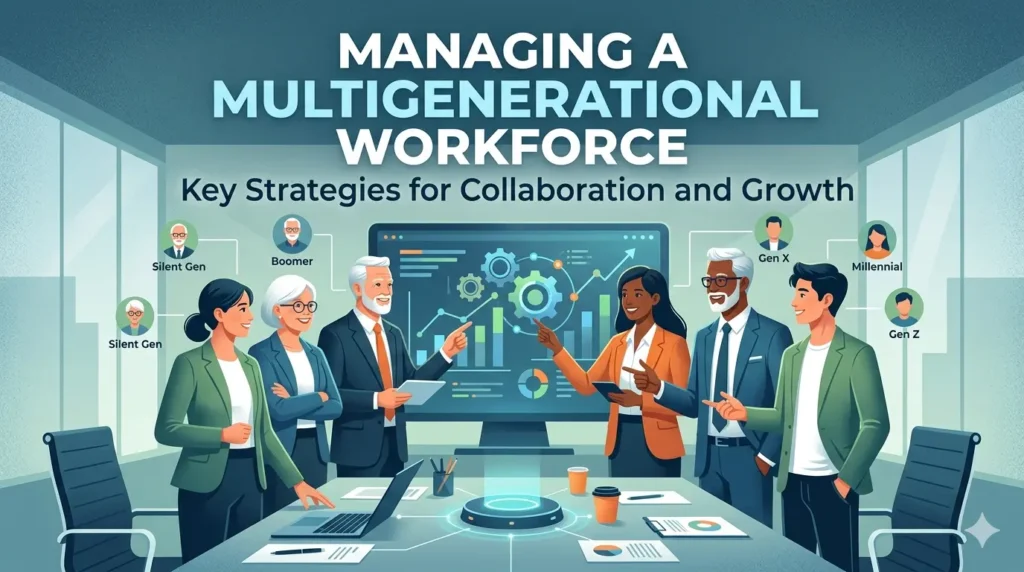
A multigenerational workforce is a community or group of people bringing their own unique ideas, skills, values, technology, communication techniques, and working styles from different generations together. Managing a multigenerational workforce is not an easy task where you suggest or implement something and every person from a different generation will adapt and start working towards it without any hesitation, problems, or differences between them.
To manage a multigenerational workforce, you should first treat everyone as an individual, learn different communication methods, develop equal mentoring relationships with different generations, and also train all generations of people to understand and adapt themselves to this rapidly changing tech world. Managers of a multigenerational workforce should make sure that the involvement of all generations is essential, not just for employee satisfaction but for long-term company success and growth. Having diverse and inclusive workplaces can result in higher employee retention and higher revenue growth; it also allows you to generate, accept, and implement new ideas, processes, products, or services.
The average lifespan for humans has been increasing, so more individuals are not only starting work at a young age but are choosing to work well after the typical retirement age. The age diversity in the current workforce is the widest ever. Currently, the workforce can be divided into five generations:
- The Silent Generation (2.0% of workers)
- Baby Boomers (18.6%)
- Generation X (34.8%)
- Millennials or Generation Y (38.6%)
- Generation Z (6.1%)
Characteristics of Each Generation
Silent Generation (born 1925–1945) These people are the most experienced. We cannot see much of this generation since they are already past retirement age. They used to have deep knowledge about the work they did; they were hardworking people with respect for bosses or superiors at the company they worked for. They prefer face-to-face communication, meetings, personal relationships, and teamwork, which helped them convince clients or customers in the most appropriate and effective way.
Baby Boomers (born 1946–1964) These people are less experienced compared to Silent Generation people and are at the edge of their retirement, but they have strong work ethics. They are very competitive, goal-oriented, dedicated towards their roles and responsibilities, and loyal. These are the ones who may struggle with work-life balance because they prefer traditional learning methods and are unable to adapt to rapidly changing technology; therefore, they expect their company to support and help them with different training and mentorship programs. This generation has a strong work ethic and dedication, and they are very loyal to their company.
Generation X (born 1965–1980) These people are independent and adaptable to any kind of situation or technology, but they do not trust others with their knowledge or ideas. They understand rapidly changing technology and are confident that they can train themselves and adapt to it. They prefer to complete training and skills development at their own speed and are flexible in e-learning. They value work-life balance, prefer direct communication, and are comfortable with any kind of communication channel like email, instant messaging, and video conferencing.
Millennials or Generation Y (born 1981–1996) These people are young and tech-savvy; they are often more engaged with work that provides a sense of satisfaction and motivation. They prefer communication through digital platforms and social media and are ready to accept new technologies. They predict that there is much more advanced technology which will overcome present technologies, and they should be ready to adapt to move forward and compete with next-generation people. To do so, they seek frequent feedback on their work or ideas and always try to work towards the requirements of their clients or customers. Eventually, they will provide a better way and always look for opportunities for growth. This generation values continuous learning as well as interactive and experimental methods to learn technology.
Generation Z (born 1997–2012) These people are very young, dynamic, and were born or brought up in the age of digital technology; they are very familiar with computers and the internet from an early age. They are very comfortable using any kind of digital communication tool. They are good at understanding new technology and adapting quickly; also, they are very interested and enthusiastic about teaching others about these technology changes. They prioritize diversity and social causes in the workplace. To dive deeper into how to attract this specific talent pool, check out our guide on Gen Z Hiring Trends.
Managing these groups of people from different generations can be problematic. Each age group has its own creative ideas and ways of working. Companies need to find ways to get everyone to work well together and implement different strategies that will encourage them to respect all generational members and help the team to perform better.
Companies today often have workers from different generations. This combination of different generation members coming together and working will lead to new ideas; at the same time, problems could arise as well. Therefore, managers must learn how to handle this type of mixed generation and come up with methods that will work for all ages. Otherwise, employees might feel ignored and that their ideas or innovations are not adding value to the company, which may lead the employees to leave the organization.
Companies should focus on the individuals who can do their best within these mixed-generation groups and help the team members to share their ideas and to learn from each other. This makes the team stronger, which will in turn help the company produce better work.
Challenges of Managing a Multigenerational Workflow
Managing teams with different age groups brings unique obstacles like communication barriers, generational beliefs and assumptions, unconscious bias, and ageism. A lack of knowledge to adapt to new technology leads to deep biases and affects the productivity of the team, which in turn affects the company’s revenue and image.
Communication Barriers Different generations have different types of communication styles. Older generation workers may often like face-to-face meetings or phone calls, which makes them feel they can convince clients more effectively. Whereas the younger generation may prefer to use digital platforms such as social media, video calls, or instant messaging, which they are comfortable using effectively. Due to this, there might be misunderstandings between different generations and important information might be missed.
Leaders should implement varied communication channels and ensure employees are trained in using different tools. For example, if a manager sends an important email, younger generation team members might not respond immediately since they fail to check their inbox regularly. Conversely, older generation team members, even though they have solutions or suggestions, may be left out if information is shared only over digital platforms they are not aware of.
Generational Beliefs and Assumptions: Different generations might have different beliefs and assumptions, as mentioned below:
- Baby Boomers: They may not be ready to accept changes or new ideas due to a lack of knowledge regarding technology changes. For example, this generation may prefer printing emails or working manually instead of using new programs or software online.
- Gen X: They are independent and want to work alone since they do not have faith in others. They focus on work-life balance and adaptability to technologies. Notable examples include Jeff Bezos, Tiger Woods, and Satya Nadella.
- Millennials or Gen Y: They are seen as entitled and addicted to new technology. They are tech-obsessed and comfortable using digital platforms predominately. They expect to find answers online quickly and expect an outstanding user experience from apps and smartphones.
- Gen Z: They may lack face-to-face social skills and prefer tasks to be done instantly. Research suggests this generation is self-driven, highly collaborative, and values flexibility, but they are often misunderstood as being lazy.
These assumptions can lead to unfair treatment. Companies should work on team-building exercises that highlight different skills to break down these barriers and focus on individual strengths rather than generational labels.
Unconscious Bias and Ageism This usually impacts workplace dynamics. Older generation workers might face difficulty learning new skills and assume they cannot compete with younger workers. Conversely, younger generation workers may be seen as inexperienced and immature in handling critical issues.
These differences might affect hiring decisions, promotions, and daily interactions. An older worker might be ignored for training opportunities, while a younger worker’s idea might be dismissed due to a lack of experience. Companies should provide bias training and create mentorship programs that include both generations. Regular assessments of company policies can help identify and eliminate age-related discrimination.
Strategies for Effective Multigenerational Team Management
Promoting an Inclusive Culture Companies should create spaces where all generations feel their ideas and experiences are valued. To achieve this, team-building activities should be conducted often, such as:
- Cross-generation mentoring: Allows both parties to act as mentor and participant simultaneously.
- Cross-functional teams: Brings together individuals with different backgrounds, viewpoints, and ages.
- Regular team lunches or outings: Helps team bonding and makes employees feel the company cares about more than just their work.
Leadership and Management Approaches Managers handling multigenerational teams need to use different styles and approaches. For older workers, managers should respect their experience and seek their input. For younger members, managers should give them the freedom to suggest ideas and provide frequent positive feedback. Leaders should focus on individual strength rather than age.
Methods to achieve this include:
- Flexibility: Allowing employees to adjust work schedules or offering remote and hybrid options.
- Goal Setting: Identifying areas of improvement for continuous learning.
- Varied Communication: Using verbal, non-verbal, written, and visual methods.
Team Objectives and Expectations for Goal Setting
Goals should be set clearly for all roles and grades so that everyone, based on their position, can determine how they need to work to achieve those goals and contribute to company growth. To do that, the following strategies can be implemented:
- Set SMART Goals: This can be achieved by ensuring your goals are Specific, Measurable, Achievable, Relevant, and Time-bound.
- Specific: You should be very clear when setting specific goals for each role and narrow them down to help with effective planning.
- Measurable: Ensure goals for different roles are measurable to track progress and development.
- Achievable: Ensure the goals set for different roles are achievable within a certain timeframe to maintain motivation and focus.
- Relevant: Ensure goals are relevant to the role and align with long-term objectives. Think about why these goals are important and how they contribute to long-term success.
- Time-Bound: Set a realistic timeframe to achieve your goal by prioritizing tasks that must be completed within a specified deadline. If you do not achieve the goal in that timeframe, do not simply jump to another one; instead, analyze where it went wrong to avoid similar roadblocks in the future.
Example: “I will earn a promotion to senior sales representative by completing the required training modules in 3 months and applying for the role at the end of the next quarter”.
- Specific: The objective is clearly set as being promoted to a senior sales representative.
- Measurable: It can be measured by the completion of training modules, tasks, and the filing of the application.
- Achievable: The person completes all necessary training required for the position.
- Relevant: The training modules are specifically relevant to sales and promotion.
- Time-bound: A specific timeframe of three months and the end of the next quarter is established.
Create a Shared Team Vision: A clear vision is important for high-performing teams; it represents what members want to accomplish together as part of the organization. An example of a good team vision is Apple’s: “To make the best products on earth and to leave the world better than we found it”. This statement clearly declares their intentions for the future.
Establish Clear Performance Metrics: Setting metrics to compare work increases employee engagement and helps create realistic deadlines. Performance metrics improve decision-making, efficiency, communication, and customer satisfaction. Key areas include:
- Employee Performance Metrics: Examples include 180-degree feedback, 360-degree feedback, absenteeism rates, work efficiency, and customer satisfaction scores.
- Sales Performance Metrics: These fall into four types: Quantity, Quality, Efficiency, and Productivity.
- Project Management Performance Metrics: These measure productivity through KPIs like average cost per hour, number of projects completed on time, and resource utilization.
- Business Performance Metrics: These include sales, profit, return on investment (ROI), and overall reputation in the marketplace.
Regularly checking these metrics helps companies track performance and allows team members to speak openly about achievements and concerns.
Using Different Communication Technologies
Multigenerational teams need to use a mix of communication tools. While older members may prefer phone calls or in-person meetings, younger members often prefer instant messaging or video chats. To work effectively, teams can use these approaches:
- Email: For formal updates, minutes of meetings, and process-related changes.
- Chat Apps: For quick responses to common or repetitive questions.
- Video Calls: For team meetings involving presentations or organizational policy changes.
- In-Person Sessions: For deep, complex discussions.
- Learning Management Systems (LMS): Providing access to learning resources for all generations to ensure consistency and efficiency in training.
Leaders should always get input from all age groups when picking communication tools and ensure everyone is trained on how to use them.
Feedback for Multigenerational Teams
Different types of feedback, including peer-to-peer feedback, help companies understand how various generations feel about the organization:
- 180-Degree Feedback: Obtained from team members, colleagues, and immediate supervisors. This helps managers offer diverse learning options like online courses, mentorship, or job shadowing. It is typically conducted once every six months.
- 360-Degree Feedback: Obtained from the employee, management, reporting heads, subordinates, and clients. This helps identify strengths and growth areas across generations and is usually done once a year.
- 720-Degree Feedback: This involves conducting the 360-degree feedback process twice a year (every six months) to monitor performance and training effectiveness more closely.
Training Methods and Evaluating Training Efficiency
To meet the needs of a multigenerational workforce, it is vital to adapt to changing learning methods. Strategies include:
- Stay Ahead of Industry Trends: Keep up-to-date with technology advancements and best practices to introduce tools that align with the expectations of all generations.
- Employee Feedback: Regularly gather feedback to understand needs and prioritize the issues most affecting the workforce.
- Adapt New Technology: Use technologies like AI, cloud computing, and automation to gain a competitive edge and improve efficiency.
- Monitor Training Outcomes: Continuously analyze data and feedback to identify necessary improvements in the workflow.
- Learning Assessments: Conduct pre- and post-training assessments to track how effectively employees have gained and implemented knowledge.
- Key Performance Indicators (KPIs): Set KPIs for training programs to monitor which generations need more support to improve their skills.
Needs of Different Generations
Managers must understand that work-life balance needs differ. Younger generations may require flexibility for innovation and personal time, while older generations may require attention to caregiving responsibilities and retirement planning. Offering flexible work timings, remote work, and job sharing can boost satisfaction across all generations. Benefit packages should also vary: younger workers may value certifications and professional development, while older workers may prioritize healthcare and retirement planning. Addressing these changing priorities allows for more effective company policies.
Wrapping It Up
Managers, HRs, and stakeholders should enthusiastically embrace the possibilities of a multigenerational workforce. Empowering employees to step outside their comfort zones through diverse training methods drives innovation and collaboration, ultimately ensuring organizational success.

