
ABSTRACT
The process of recruitment has always been a complex, critical, sensitive, and time-consuming task, which often gets afflicted by issues of security, integrity, and transparency. Blockchain technology, with its secure, digital, decentralised, immutable, and transparent nature, emerges as an innovative and promising solution to these challenges, making the hiring process smoother and more efficient, facilitating and enhancing organisational growth, productivity, and profitability.
In this paper, we will explore the objectives, findings, interpretations of the findings, benefits, limitations, and future directions of blockchain technology in the recruitment industry. We shall also discuss how this technology is providing significant insights to HR professionals and other organisational peers and associates related to the industry, and is reorganizing the entire recruitment process by ensuring it is more reliable, convincing, and hassle-free for hiring executives.
INTRODUCTION
What is Blockchain Technology?
The process of recruiting is a cardinal part of the HR management system; it holds utmost significance as it directly influences the quality, performance, and achievements of the workforce and productivity of an organisation. Traditional or conventional HR management systems, though established and acquainted, often involve manual processes that are not only time-consuming but also prone to several flaws and irregularities.
Hence, it undermines trust and transparency, and primarily, it is the reason why nowadays, in general, organisations often tend to avoid such disorganised and tedious processes.
How does it work?
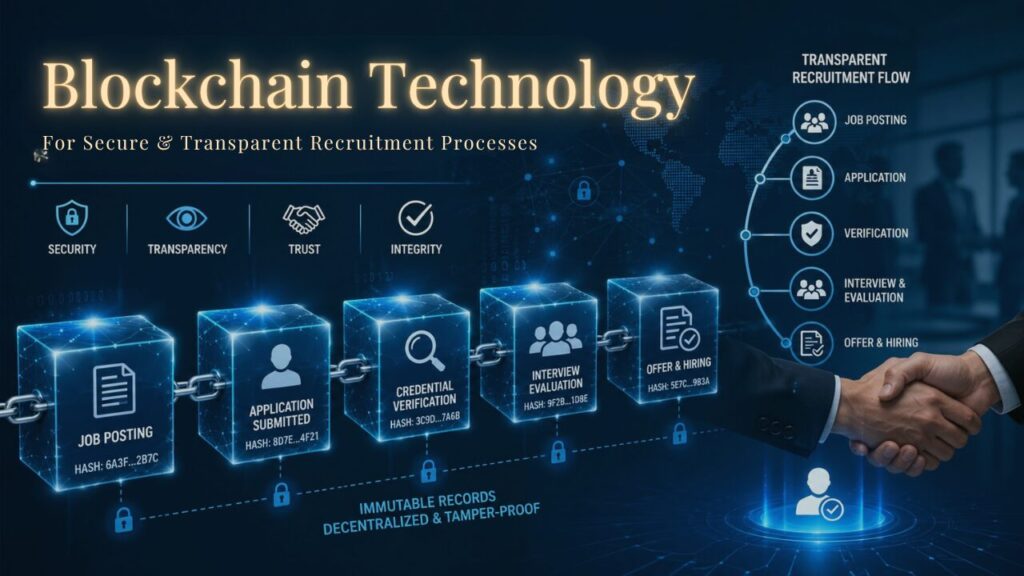
Blockchain technology that works as an indisputably verified and digitalised ledger system, with its promise of security, transparency, integrity, and immutability, proves to be highly effective by reducing risks associated with data tampering, ensuring the authenticity and integrity of candidate details and credentials, making the whole hiring process faster, easier, equitable, and trustworthy for an organisation.
The technology even utilises cryptographic algorithms and digital signatures for data integration, as it strengthens confidentiality and other privacy issues.
What is its structure?
The structure and work function of the digital ledger, i.e., blockchain, is truly unique and interesting. It works as a network where each piece of “block,” or information, is linked to the previous one, forming a chain-like structure. The blocks contain lists of digitally protected transactions, which once added cannot be altered or changed without changing every subsequent block, and for that entire process must undergo scrutiny and unanimous approval or validation from the network.
These built-in security and transparency features make Blockchain a fitting technology for HR applications.
OBJECTIVE
The goals of implementing or utilising blockchain technology for a secure, transparent, and trustworthy hiring process are as follows:
- Safeguarding data privacy: Blockchain technology aims to build a secure and transparent candidate database, which stores and encrypts the confidential data, and prevents it from any sort of manipulation or alteration.
- Amplifying transparency: Blockchain-based solutions provide a lucid and auditable record of the hiring process.
- Enhancing trust: Blockchain technology instils and boosts trust among both internal and external stakeholders, such as hiring managers, HR professionals, recruitment agencies, job candidates, interviewer panels, organisation’s leadership, etc
- Mitigating fraud and forgery: Blockchain technology lays stress upon precise and scrupulous background checks and verification of various documents and credentials of the candidates.
- Streamlining the hiring process: Blockchain technology can accomplish tasks and assignments in an automated manner, and it can also formalise recruitment agreements through smart contracts, thus reducing administrative burdens.
- Strengthening security: Blockchain technology encrypts sensitive content and information related to the hiring procedures and restricts unauthorised access.
- Advocating fairness and branding the employer positively: Blockchain empowers candidates to manage their profiles and track their applications in a swift and appropriate manner. It guarantees that all candidates are seen or treated equally without any bias and thus optimises candidate experience.
- Reducing administrative workload: By automating administrative tasks related to the onboarding process, such as background checks, verification of documents, data entry and management, authentication and validation, tracking candidate progress, managing paperwork like contracts and consent forms, preventing fraudulent activities, etc.
FINDINGS
Long-drawn-out research and analysis into Blockchain’s growing prominence and popularity in the hiring process highlight multiple key takeaways, such as
- Data storage security: Blockchain uses special codes and storage to protect sensitive and confidential digital data from unauthorised access, that bolster privacy and reduces the potential risk of data breaches. It ensures data accuracy, integrity, accessibility, and consistency. It also implements an authentic and authorised mechanism that restricts unapproved data access and even has provisions for quick data backup and recovery.
- Transparent and decentralised nature: The transparent and tamper-proof characteristics of blockchain foster integrity and trustworthiness in the hiring process, lowering the potential for misrepresentation and dishonesty. Likewise, its decentralised and immutable attributes encourage clarity and openness between job seekers and job givers, regulating all sorts of unscrupulous and fraudulent exercises.
- Efficiency: One of blockchain’s plus factors is its long-term efficiency. By having a digitalised integrated system that centralises candidate data, companies can avoid duplicating data collection efforts for candidates applying for more than one position, especially when hiring extensively or handling a large pool of job seekers. Given that efficiency rests heavily on technological preparedness, small firms and companies that do not have adequate tech infrastructure may face difficulties in implementing blockchain-based solutions.
- Prompt and genuine verification: Blockchain plays a crucial role in optimising functional efficiency by accomplishing various administrative tasks without human intervention that were previously done manually. It allows fast, reliable, and error-free operational verification of candidate credentials. The smart contracts can automatically authenticate documents related to the background of a candidate, scrutinise his identity proofs, educational certificates, professional skills or knowledge, previous work experiences, portfolios, etc., and thus eradicate lengthy, cumbersome, and time-consuming manual processes. The smart contracts also speed up the hiring process and guarantee consistent and precise execution of every stage of the selection.
- Automated modus operandi: Many widespread studies reveal that automation can cut recruitment time by 30-50% compared to the hand-operated traditional approaches, which serve as a pivotal advantage for companies with high-volume hiring needs or those operating in fiercely competitive job markets.
- Economical and cost-effective: By utilising blockchain technology, the necessity for intermediaries like job agencies or consultancies diminishes, resulting in curtailed costs for job postings, agency commissions, and hiring staff. Even, according to some studies, employers leveraging blockchain can potentially result in business-related cost reductions up to 20%.
- Streamlining the hiring process: With blockchain-powered smart contracts, recruitment or onboarding processes such as candidate sourcing, resume screening, shortlisting, interview scheduling, and background verifications are automated, facilitating faster and more effective hiring timelines. Moreover, it significantly reduces dependency on third-party services in various ways, such as automating intermediaries, decentralising execution, and enabling trustless transactions.
- Accessing global talents: Blockchain transcends geographical boundaries and limitations. It opens a diverse worldwide pool of job seekers for employers.
- Environmental support: Blockchain minimises reliance on physical documents during the hiring process, which can substantially reduce paper usage by storing all sorts of candidate-related data and information securely in an encrypted digital format. This shift restricts the waste of paper and other resources, saves expenses and advocates for environmental sustainability.
- Reducing bias: Blockchain-based hiring platforms concentrate on verified skills and experiences of the candidates that minimise partiality and favouritism in the manual selection process. This technology has the ability to process data objectively based on pre-determined objective criteria without human manipulation, thus creating a fairer and desirable opportunity for all job applicants. By doing this, we can build a recruitment system that prioritises meritocracy and inclusivity.
- Regulatory compliance: Blockchain assists organisations in adhering to strict privacy regulations by providing high security and transparency while complying with regulations such as GDPR (General Data Protection Regulation). It also helps meet privacy regulations in sensitive sectors like banking, healthcare, etc.
- Real-world applications: Companies like Wipro, HCL, Workwolf, IBM, Infosys, SoluLab, RedDuck, Sony, TCS, etc., are actively working to develop Blockchain-based systems to authenticate learning and professional achievements as well as certification programs. By doing this, they are actually creating career profiles and connecting the candidates with employers directly.
INTERPRETATIONS OF FINDINGS
The study’s upshot on blockchain technology for recruitment processes can be split into three segments.
The first segment gives us a detailed picture of the positive implications of this technology, especially in boosting security, enhancing transparency, improving efficiency, reducing impartiality, and building trust in the hiring process.
For instance, companies leveraging blockchain in HR systems have experienced a 47% surge in operational efficiency and a 33% cost savings, while ensuring utmost data integrity, empowering end-users to exert greater control over their personal data and assuring foolproof privacy of the data from any kind of unauthorised access, data breaches and cyber-attacks.
Other key positive takeaways include blockchain’s decentralised verification of candidate data, immutable and tamper-proof records, productivity, trackable internal mobility and compliance, streamlined nature, automation of critical tasks related to the screening and selection part of a hiring process using smart contracts, reduction of unconscious bias by focusing only on genuine and verified skills and experiences of a job seeker and most importantly saving time, money, and other resources by accomplishing activities in quick pace.
In the second segment, we shall discuss the practical applications of blockchain in recruitment, especially its role in verifying the candidate credentials, securing employee data management, and simplifying the entire hiring process, making it more effective and transparent.
With the rise in data breaches, companies require a resilient and trustworthy solution to safeguard sensitive data and information, and for that, they prefer blockchain for its feature: a cryptographic algorithm that reinforces supreme data protection.
Blockchain’s decentralised architecture and immutable ledger provide a highly secure remedy for managing data, making it virtually impossible to alter or tamper without detection.
Also, the organisations can record while sharing data or other transactions across multiple operators directly in a most reliable and clear way that upholds data privacy, saves time, and makes the process swift and flawless.
Furthermore, by utilising blockchain, the companies can encrypt sensitive data, grant access only to authorised personnel, and thereby enhance data privacy and regulatory compliance. Blockchain-powered smart contracts can automate hiring processes, resulting in speedier hiring cycles and a more seamless and improved candidate experience.
The concluding segment explores the future prospects and potential advancements of blockchain technology. First of all, the widespread adoption and integration of blockchain technology in recruitment hinges on overcoming regulatory, technical and scalability challenges.
The research findings can also identify directions for future research, such as usability and interoperability. Moreover, to ensure optimum usage, augmenting compatibility and successful implementation, blockchain-based hiring platforms must be integrated with existing HR infrastructure and processes.
Lastly, continuous monitoring and evaluation of those platforms will be necessary to build their efficacy, productivity and to identify the areas for improvement.
BENEFITS AND ADVANTAGES
» Automation: Blockchain streamlines HR processes by automating tasks such as credential verification, resume screening, and background checks, resulting in significant time and cost savings. According to an IBM case study, blockchain-based background checks reduced costs by 50% and boosted efficiency by 80%.
» Transparency: Immutable records provide an accurate, tamper-proof, and transparent way to store sensitive data, ensuring its authenticity and reliability, which in turn fosters trust and confidence in the HR process.
» Cybersecurity: By leveraging blockchain’s encrypted and decentralised framework, employers can maintain compliance, manage hiring processes, safeguard data and prevent fraudulent activities.
» Streamlines Cross-Border Hiring: According to a 2022 Deloitte report, blockchain slashes verification time by up to 75%, enabling faster onboarding of international employees, while also reducing administrative costs by up to 30%, making global hiring more cost-effective.
» Faster, Cheaper & Efficient: Blockchain accelerates the verification process for job seekers, making the hiring process faster and reducing HR costs by up to 80%, thereby improving the overall efficiency of the system that traditional ones lack.
» Trustworthiness: This technology hugely fortifies the mutual bond between employers, candidates, and recruitment agencies. The employers can make more pinpoint and accurate decisions to fill vacancies. Simultaneously, it also helps to reduce time-to-hire and improve candidate experience and satisfaction.
» Compliance with Regulations: Leveraging blockchain can facilitate adherence to data protection regulations, lowering the associated threats of non-compliance more effectively.
CHALLENGES AND LIMITATIONS
Despite having many advantages, the installation of blockchain in talent management is relatively new and lacks research. This highlights the necessity for further detailed and extensive research to bridge the existing knowledge gap on practical and effective blockchain applications in recruitment.
The adoption of blockchain technology in recruitment is hindered by various challenges and obstacles, such as regulatory uncertainties, substantial upfront costs, and the need for specialised technical expertise. It is essential to comply with data privacy regulations, especially protecting candidate data, which is paramount, and that is why immature regulations and legal uncertainties can often reduce organisations’ interest in adopting this technology.
Apart from these, there are many other issues like internal resistance and reluctance of the employees, complexity of technology, adoption gap, especially for the small companies and firms, need for strategic solutions or cross-sector collaboration, etc. Also, blockchain networks often encounter scalability issues when handling a large volume of transactions, which is certainly a major issue.
FUTURE OF BLOCKCHAIN
By implementing blockchain, recruitment processes gain impetus that can transform the entire hiring landscape into a more empowered and effective one.
It pledges to create a streamlined, efficient, secure, transparent, cost-effective, and easily accessible hiring framework. Blockchain emerges not just as a technological breakthrough but as a cornerstone in establishing trust and transparency specially when it comes to verifying candidate credentials, sharing transactions, maintaining highly confidential digital records or statements, and protecting data privacy.
As a result, the utility of blockchain in recruitment is likely to become mainstream or a norm very soon, rather than an exception, heralding a new era of digital recruiting.
This investigation not only emphasised the transformative potential of blockchain but also underscores its role as a catalyst that possesses the ability to drive innovative and meaningful change in the recruitment industry. Through increased awareness and proactive adoption, this technology could yield notable advantages that would greatly revamp and reshape the hiring landscape and benefit both job givers and job seekers.
CONCLUSION
Blockchain recruitment is not just a trend; it represents a fundamental shift in talent acquisition and conscientious verification. By integrating blockchain with HR processes, organisations can revolutionise the way HR operates and functions, nurturing a secure and transparent environment that minimises risks like fraud, inefficiencies, and data breaches, ultimately leading to a more structured and dependable HR ecosystem.
As Blockchain technology evolves, HR teams and recruiters get the edge they require in a fast-paced hiring landscape. They can easily unlock substantial advantages such as streamlined processes, secure data handling, and stronger stakeholder-employee trust. To maximise this potential, HR professionals must stay updated on the latest developments and actively seek ways to integrate blockchain into their workflow.
Thus, with growing adoption and popularity, blockchain technology is set to become the backbone of global hiring systems, characterised by decentralisation, transparency, and candidate empowerment.
REFERENCES
- [1] https://www.mokahr.io/myblog/blockchain-hr-future-secure-hiring/ (Moka)
- [2] https://www.truscholar.io/blog/how-blockchain-is-changing-the-recruitment-process (TruScholar)
- [3] https://ccy.com/blockchain-in-recruitment-ensuring-transparency-and-trust-in-hiring-executives/ (Cochran, Cochran, and Yale)
- [4] https://www.hackerearth.com/recruit/glossary/blockchain-recruitment (HackerEarth)
- [5] https://goskillscafe.com/blockchain-enhancing-recruitment-processes/ (GoSkillsCafe)
- [6] www.sciencepubco.com/index.php/IJET (Research paper on ‘A study on blockchain technology’, International Journal of Engineering & Technology)
- [7] https://dwightpatterson.co.uk/blockchain-in-hr-ensuring-secure-and-transparent-processes/ (Dwight Patterson)
- [8] https://jisem-journal.com (Journal of Information Systems Engineering and Management)
- [9] https://www.linkedin.com (LinkedIn; Blockchain in recruitment)