
Most organisations treat onboarding as a day. The new joiner signs forms, meets the team, gets a laptop, and is told to settle in. Three months later, HR is surprised when they resign.
The data says this is the norm rather than the exception. Gallup finds that only 12% of employees strongly agree their organisation does a great job of onboarding new employees. The same research cites SHRM figures showing turnover can reach 50% in the first 18 months of employment, with each replacement costing roughly six to nine months of that person’s salary.
Onboarding, properly understood, is organisational socialisation: the process by which a new hire acquires the knowledge, skills and relationships to become a productive member of the organisation. It is not a form-filling exercise, and it does not end on day one. This article sets out what effective onboarding involves, a 30-60-90 day structure you can apply, eight practices that make the difference, and how to measure whether any of it is working.
Key takeaways
- Onboarding is a process of months, not a one-day orientation event.
- Most new hires decide early whether they will stay, which makes the first 90 days decisive.
- Pre-boarding, a buddy or mentor, and clear role expectations do the most work.
- Digital tools scale onboarding but cannot replace human contact.
- Without KPIs, onboarding quality is invisible until someone resigns.
Onboarding vs Orientation: Not the Same Thing
These two words get used interchangeably, and the confusion is the root of most weak onboarding programmes.
Orientation is an event. It happens once, usually on the first day or week, and covers the essentials: paperwork, policies, introductions, a tour, system access.
Onboarding is a process. It begins when the offer is accepted and continues for three months to a year, covering role clarity, skill-building, relationships, cultural integration, and performance expectations.
Orientation is one component of onboarding. An organisation that runs a good orientation and calls it done has completed perhaps a tenth of the job.
Why Onboarding Decides Retention
New hires form their judgement about an employer fast. Qualtrics reports that 86% of employees decide whether to stay or leave within their first six months, and that around 28% of new hires leave within 90 days.
What goes wrong in those first weeks is rarely dramatic. It is role confusion, no one to ask, unclear expectations, nothing meaningful to do, and no feedback on whether early work was acceptable. Each is a failure of process rather than of the person, and each is fixable.
The business case is straightforward: weak onboarding produces slower time to productivity, higher early attrition, repeated recruitment cost and the hidden cost of managers re-explaining the same things to successive joiners.
The Four Phases of Onboarding
1. Pre-boarding (Offer Acceptance to Day One)
The gap between acceptance and joining is usually wasted, and it is where offer-drop risk sits. Use it: send documentation and policies online, share a welcome message from the team, provide a short induction video, confirm first-day logistics, and get the laptop, email account and system access ready before arrival.
The effect is simple. A new hire who already knows where to go, who they will meet and what the first week looks like arrives with less anxiety and more attention to spare.
2. Orientation (First Days)
Cover the three things that genuinely matter: make the person feel welcomed, explain the organisation’s purpose and culture honestly, and state performance expectations clearly. Compliance and paperwork are necessary but should not consume the first day.
3. Role-Specific Training (Weeks 2 to 8)
Generic induction content teaches nobody how to do their actual job. Training here should be hands-on and tied to real tasks: shadowing, guided practice, a small live piece of work with review. Progressive is the operative word, moving from observation to supervised work to independent delivery.
4. Transition to the Role (Months 2 to 12)
This is the phase most programmes skip entirely. It covers continued check-ins, a first development plan, integration into the wider team and the point at which the new hire is treated as a full contributor with their own goals.
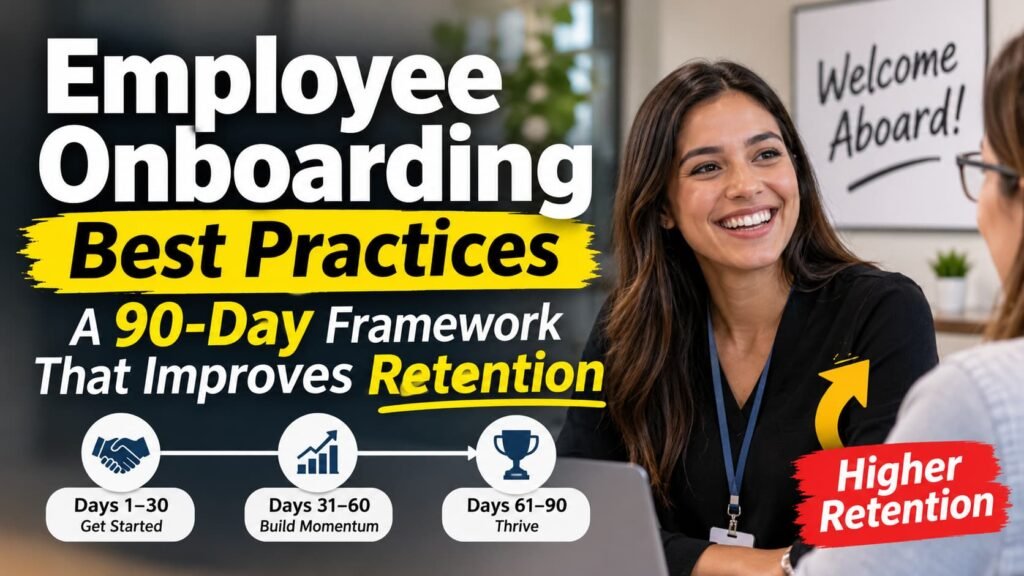
A 30-60-90 Day Onboarding Plan
A phased structure gives both the new hire and the manager something concrete to work against.
| Period | Focus | What HR and the manager do | Success check |
|---|---|---|---|
| Days 1–30 | Orient and absorb | Welcome kit, buddy assigned, role expectations in writing, systems training, introductions across functions | Can explain their role and who to approach for what |
| Days 31–60 | Contribute | A small, real project with a defined outcome; mid-point feedback; cross-department exposure | Delivered a piece of work to standard with support |
| Days 61–90 | Operate independently | A more complex task, 90-day review, first development plan, goals for the next quarter | Working independently; manager confident in their output |
Keep it written and shared. An onboarding plan that exists only in a manager’s head is one leave application away from falling apart.
8 Onboarding Best Practices
1. Start Before Day One
Everything that can be done before joining, should be. Paperwork completed in advance buys back the first day for the work that actually builds commitment.
2. Assign a Buddy or Mentor
This is the highest-return, lowest-cost practice available. A named colleague who answers the small questions, the ones nobody wants to take to a manager, removes most early friction. High-performing organisations are substantially more likely to assign a mentor or coach during onboarding.
3. Put Expectations in Writing
Harvard Business Review’s guide for first-time managers recommends a detailed description of tasks, responsibilities and expectations for the first three months, with performance metrics that are measurable, relevant and achievable. Role clarity is what the new hire is actually anxious about in week one.
4. Make Learning Hands-On
People learn a job by doing it. Give real work early, with supervision, rather than two weeks of presentations. This is the same principle that governs employee development generally: experience teaches more than classroom time.
5. Build In Social Integration
Team lunches, informal introductions, a session with a senior leader. Relationships are what make someone feel they belong, and belonging is what makes them stay.
6. Use Technology for Scale, Not Substitution
An LMS, a self-service onboarding portal and short video modules let you deliver consistent onboarding across locations and remote teams. They work as a supplement. A fully automated onboarding with no human contact produces a well-informed new hire who feels like a ticket in a queue.
7. Schedule Check-Ins and Actually Hold Them
Weekly in month one, fortnightly in months two and three, then monthly. Ask what is unclear and what is getting in the way, not just whether everything is fine. Frequent, specific feedback early on prevents the problems that surface in a performance review six months later.
8. Train the Managers
HR designs onboarding; the line manager delivers it. Give managers a checklist, a 30-60-90 template and clear accountability for the 90-day review, or the best-designed programme will be applied inconsistently across departments.
Digital and Remote Onboarding
Hybrid and distributed teams have made digital onboarding standard rather than optional. Practical components include a self-service portal for documentation, an LMS for role-specific modules, recorded walkthroughs of systems and processes, and interactive formats such as quizzes or gamified modules that hold attention better than a slide deck.
Two cautions. First, remote joiners miss the incidental learning that happens in an office, so the informal contact has to be scheduled deliberately: a buddy call, a team coffee, an open session with a leader. Second, digital tools are good at delivering information and poor at creating belonging. Guides from Workable and Qualtrics both land on the same point: design the experience from the new hire’s perspective, then decide which parts a tool can carry.
How to Measure Onboarding Effectiveness
If you cannot measure it, you cannot defend the budget for it. Track:
- 90-day and first-year retention of new hires, split by department and by manager.
- Time to productivity: how long until a new hire works independently at the expected standard.
- New hire satisfaction: a short pulse survey at 30, 60 and 90 days.
- Manager confidence in the new hire at the 90-day mark.
- Completion rates for onboarding activities, which show where the process quietly breaks down.
- Early attrition reasons from exit conversations with anyone leaving inside six months.
Reviewing these together is where HR analytics earns its place: one weak manager or one department with no buddy system usually shows up in the retention numbers long before anyone mentions it.
Common Onboarding Mistakes
| Mistake | What to do instead |
|---|---|
| Treating orientation as the whole of onboarding | Run a 90-day plan with scheduled milestones |
| Day one spent entirely on paperwork | Complete documentation during pre-boarding |
| No single person to ask small questions | Assign a named buddy on day one |
| Vague expectations | Written responsibilities and metrics for the first three months |
| Weeks of passive training | Real work early, with supervision and review |
| Check-ins scheduled but skipped | Hold the manager accountable for the 90-day review |
| No measurement | Track 90-day retention, time to productivity and new hire feedback |
Frequently Asked Questions
How long should employee onboarding last?
At least 90 days, and up to a year for complex or senior roles. A 30-60-90 day structure covers the critical period, with lighter check-ins continuing through the first year.
What is the difference between onboarding and orientation?
Orientation is a one-off event covering paperwork, policies and introductions. Onboarding is the longer process of building role clarity, skills, relationships and cultural fit, and it includes orientation as one step.
What is pre-boarding?
Everything that happens between offer acceptance and the first day: documentation, welcome communication, induction material and equipment setup. It reduces first-day anxiety and lowers the risk of a candidate dropping out before joining.
Who is responsible for onboarding, HR or the manager?
Both. HR designs the programme, provides templates and tracks outcomes. The line manager delivers the day-to-day experience, sets expectations and runs the check-ins. Onboarding fails most often where that handover is unclear.
How do you onboard remote employees effectively?
Ship equipment and access before day one, use a portal and an LMS for structured content, and schedule the informal contact that would otherwise happen naturally in an office: a buddy call, team introductions and regular video check-ins.
Conclusion
Onboarding is one of the few HR processes where the cost of doing it badly is measurable and the fix is cheap. A written 90-day plan, a named buddy, clear expectations, real work early and check-ins that actually happen will outperform most expensive interventions available to an HR team.
Given that only 12% of employees think their employer does this well, there is a good deal of room to be the exception. Start with the next joiner: write the plan, assign the buddy, and book the 90-day review before day one.
What has made the biggest difference to onboarding in your organisation? Share it in the comments.
Learn to Design Onboarding That Works
Building an onboarding programme, training managers to run it and measuring the outcome are core HR skills. HR Spot’s HR Generalist course covers onboarding alongside recruitment, payroll, performance management and employee relations, and our recruitment certification covers the hiring process that feeds into it. Not sure which fits your experience? Use the HR course finder or talk to a counsellor.
References
- Academy to Innovate HR. Engaging onboarding activities for new hires.
- Gallup. Why the onboarding experience is key for retention.
- Harvard Business Review (2023). A guide to onboarding new hires (for first-time managers).
- HR Exchange Network. Employee onboarding experience.
- PeopleSpheres. What you need to create an effective onboarding process.
- Qualtrics. Improving the employee onboarding experience.
- Workable. Employee onboarding process: 7 steps to successful onboarding.

