
Abstract
Clear HR communication is very important whenever a policy changes. It can directly impact employee trust, performance and compliance. This paper explains the use of effective HR communication during policy change, best practices and potential issues. It illustrates how transparent communication with employees can lead to a successful working environment, whilst unclear communication could lead to disruptive, non-tolerant and trust issues. The paper concludes that a clear understanding of HR policies helps in a positive organizational culture during times of change.
KEYWORDS: HR communication, clear communication, employee engagement, policy changes, transparency, organization culture, HR policies.
Research Discussion:
HR Policy
HR policy is a set of company rules and regulations, procedures, and guidelines for employee management. HR teams and department managers play key roles in implementing and enforcing these policies.
They are extremely essential for establishing a framework within which the company can make decisions. These policies ensure that employment laws, labour laws and company laws are followed. Some policies are made according to the law, and some are created according to the company for its business development. Some of the examples of essential HR policy are:
Health and safety: ensures the safeguarding employee from accidents or near miss, on the workplace.
Disciplinary action, dismissal and grievance: it ensures that employees are not dismissed on an unfair trial. All the disciplinary documents are documented, and further procedures are followed according to the organization and labour law.
Employment classification: it explains about the employee working on full-time, part-time, volunteering, casual and contract hours, minimum working hours and overtime for each type of worker.
Pay and timekeeping: methods of payment, on which day payroll is made, payroll cut-offs and educating employees on the methods for documenting their hours.
Time off and leave: UK laws made it mandatory for a statutory leave of 28 days per year. It outlines the leave employees are entitled to, as holiday leave, sick leave and family leave.
Meal and break periods: it ensures the employee has a break entitlement, and the employee has to abide by it. To ensure employees know they are entitled to rest breaks to avoid burnout or overworking.
Equality and diversity: it ensures employees are dealt with fairness and do not discriminate on the grounds of race, gender, caste, or religion.
Punctuality and attendance: it ensures the employee must be on time, working according to their hours in their contract and remote working is enforced accordingly. This policy also explains the procedure for notifying your supervisor if you are late or unable to attend work and outlines disciplinary action that the company might take for frequent occurrences.
These policies ensure that they are legally compliant.
The core functions of HR policies are:
- Compliance and legal protection: it ensures the policies are followed according to labour law and company HR laws to avoid any penalty and punishment.
- Workplace consistency and fairness: it ensures all employee matters are solved without any bias or on any discriminatory grounds.
- Employee rights and responsibilities: it ensures what are employee’s rights and responsibilities on the company and vice versa.
- Operational efficiency: it ensures the smooth flow of recruitment, onboarding, and disciplinary issues without any burden on the company’s environment.
- Risk management: it identifies risk and potential causes of any violation or violence/conflict to avoid any legal consequences.
- Workplace culture and employee engagement: it ensures professional ethics, behaviour, conduct and employee retention are encouraged.
- Dispute resolution and conflict management: It ensures conflict management and grievance are handled appropriately.
- Performance and productivity standards: it ensures the employees are performing according to the company benchmark, and regular feedbacks are given to improve their productivity.
- Compensation and benefits framework: it ensures salaries, benefits, allowances, and incentives are given on time to prevent any disputes.
- Diversity, equity and inclusion: it ensures hiring is done on a fair basis without any discrimination on the grounds of complexion, caste, religion, or gender.
How a Policy is Made:
Identify the need for change: the first step is to identify why this policy being made is necessary.
Consult key stakeholders: gathering input from HR team, HR managers and legal advisors, feedback from employees is taken to see if it’s practical and beneficial.
Draft the policy: a well-crafted policy must include purpose, scope, details, consequence and review dates.
Communicate the change: effective communication is crucial for the implementation of policies. It can be done through various channels, Question Answer, feedback forms.
Provide training and support: new policies require new skills and technology to learn and adapt. It can be done through various workshops, guidelines, managing training and ongoing support from a manager to make the transition smoother.
Monitor and review: after the implementation of a new policy, it is very important to know how it is effectively applied. Regular follow ups and, reviews, or feedback will be helpful in knowing the areas of improvement.
Stay flexible and open to feedback: even after careful planning and implementation of policies, some policies fail and be open to feedback from employees.
Implementing a policy can be a complex process, but it can be successfully implemented with a well-planned approach, clear communication, ongoing support from an HR consultant, and ongoing training and ongoing support can smoothly successfully build a positive working environment.
Potential Risks when Policies are Changed During Project Runtime:
- Policies can be changed if they are outdated. These changes can directly impact the implementation of projects, especially if the project has been initiated and its timelines.
- It is very important which guidelines to follow the guidelines until the project is completed, whether new or old.
- The changes in policies can impact budgets as well.
- Restructuring can shift project priorities.
- Updates can cause delays and require training of employees.
Ways in which HR can Communicate with Employees During Policy Changes:
When HR communicates clearly about HR policy changes, it can ensure employees are valued and regarded as an integral part of the organization. A change in HR policy can be initiated by memos, newsletters, mass emails, meetings and communication metrics.
Employees want to stay valued. They want to be informed of the changes. If they feel they are being disregarded, it can influence the projects to be successfully completed on time.
Unclear communication make employee feels they are being kept in the dark.
All policies must be communicated clearly, whether a company is going through organizational change or altering its work environment.
Clear HR communication about policy change helps employees to enhance productivity and performance management. Clear communication between employees is a very important factor for the organization’s success or downfall. Whenever there is improper communication between employees during policy change, it can lead to potential challenges and performance issues. It is very crucial because clear information from the HR can help the employee perform their roles effectively, thereby avoiding any disagreement, confusion and inconsistencies
Whenever HR clearly communicates about the policy changes, it becomes very evident that every employee has to follow these policies. This set of protocols filters through every level of organization.
It helps in a better understanding of the company’s priorities and can model their actions accordingly.
Employees feel content and grateful if they are kept informed throughout the policy change process, which will help them align their efforts in a new direction.
Steps to be taken after a policy change:
- Encourage managers to host a Question & Answer round after policy changes.
- Use surveys or polls to check for understanding.
- Repeat messages across portals or channels.
- Watch for signs of confusion or non-compliance and act fast.
- Delivering email follow-ups/notifications.
Unclear communication leads to misinformation, rumours, uncertainty in future roles, distrust, legal liabilities, inconsistent employee behaviour, and an increase in support tickets.
Below are some potential pitfalls to look out for if there isan inconsistency in communication:
- Excessive HR policies can result in inefficiencies, reduced productivity and frustration due to a slow decision-making process.
- Sometimes policy change can fail to address the unique needs of different departments.
- Employees may feel policy changes are stressful, restrictive, and unnecessary if not implemented with communication and feedback.
- Policy change can also result in employee attrition, damaged relationships, loss of customers and difficulty in retaining top talent.
- According to the 2023 report, the state of business communication showcased workers’ views on poor communication.
- 50% have admitted that it has increased their overall stress levels.
- 34% have said that poor communication has decreased their job satisfaction.
- 30% have claimed that miscommunication has decreased their professional confidence.
- 22% of them have considered looking for a new job due to poor communication.
- A recent report by HexOS found 30% employees rated their manager seven out of ten because they are frustrated by unclear communication from their bosses.
In this section, we will explore some case studies of well- known companies that have strong communication practices in HR.
- GOOGLE: It uses weekly meetings to address any concerns and questions from employees. It encourages open-door policies where employee can freely express their opinions and ideas.
- SOUTHWEST AIRLINES: It is known for its transparent communication practices in HR. It offers a medium for employees to voice their opinions, such as roundtable discussions, surveys, and suggestion boxes. To make every employee feel heard and valued.
- NIKE: Nike’s HR department utilizes tools like town hall meetings, focus groups and team building activities to enhance two-way communication at all levels within the organization.
Case Study 1:
A U.S.-based media conglomerate decided to bring a shift in policies for 15,000 hourly employees to salaried employee where the new absence, leave, and time tracking modules were in place to streamline policy administration.
PROCESS:
- Conduct meetings to plan and execute communications.
- Execute marketing for policy change
- Conduct training for time tracking system implementation, facilitator-led training, and screen recordings.
This change in policy has significant challenges and implications, which are mentioned below:
- Overtime Pay: Salaried employees are not eligible for overtime pay for hours in a week, unlike hourly employees.
- Working Hours and Flexibility: Salaried roles often come with an expectation of more responsibility and potentially longer workweeks, though they may also offer more flexibility in daily schedules.
- Communication is Crucial: The employer should have a clear conversation with the employee, explaining the new pay setup, job responsibilities, and the lack of overtime pay, to ensure buy-in and avoid future confusion.
Case Study 2:
In 2015, URBN –Urban Outfitters experienced instability when their HR policies were changed. It was mentioned in the policies that the staff have to work for free as a volunteering opportunity. The policy states that every store-based employee has to work an additional 6 hours as a volunteer during the seasonal period. The main scope of this policy was team building exercise. This impacted negatively on the employees as no financial compensation was paid by the company. The employees were reluctant to do so, which created chaos in the company. All the employees in URBN were paid minimum wage, hence volunteering for free was not an option for them to go ahead. According to UK employment law, as employees are paid minimum wage, unpaid extra hours would be illegal.
In this case, what HR could have done to prevent this situation:
- HR could have arranged temporary staffing during seasonal times to avoid any inconvenience for already working staff.
- The company should have paid more to the staff for extra hours to reassure them that they are valued.
- The thin line between volunteering and paid employees should never be compromised.
- Volunteers should be provided with food, accommodation and travel allowance. Though volunteering is not subject to a contract, their daily allowance should always be in force.
The effects of going through an unfair suspension or dismissal process on various domains of well-being, depending on the severity of impact:
| Area of life | Mild impact | Moderate impact | Severe impact |
| professional | Job insecurity | Deskilled, difficult to get work | unemployable |
| reputational | Social stigma | Spurned by others | Reputation destroyed |
| financial | Strain on finances | Using most of the savings | Have to sell home |
| Health | Minor health complaints | Major illness | Death |
| Emotional | Anxiety | Depression | Death |
| Social | Isolation | Marginalization | Ostracisation |
| Family life | Disruption | Major strain | Divorce or loss of contact with children |
Case Study 3:
Albany HR, the outsourced partner, helped its client update their outdated HR policies. These policies need to be refreshed for the growing business. The employer was keen to introduce new policies which support the needs of both managers and employees. However, limited resources and competing priorities made policy development an ongoing struggle for the team. It seems that the changes in HR policies made it difficult for the employees to understand and follow.
Steps taken by HR:
The HR leadership team sought a solution to be implemented to streamline HR policies, which provided clarity and created user-friendly policies that are easy to understand and follow.
Solution:
A design was implemented that allows employees to find information easily and independently. A comprehensive gap analysis was conducted on all existing HR policies. This helped in identifying areas in need of revision and highlighted any missing policies.
Albany HR partners implemented a policy development plan that includes both updates and additions of new policies. They formed a team consisting of the HR team, marketing colleague, HR consultant from the Albany group who created a user-friendly policy template. This plan helped in branding and accessibility across all HR policies.
Albany HR maintained close contact with the HR department to ensure policies were legally aligned with company values.
Result: The user-friendly layout and language in the new policies made it comfortable and convenient to understand. The HR team ensured this plan was helpful in creatinga collaborative and positive work environment.
Case Study 4:
Peterborough and Stamford Hospitals NHS Trust is a part of the global UK healthcare system. It has a huge staff of more than 4,000. The trust later merged with Hinchingbrooke Health Care Trust in 2017. It is now known as North West Anglia NHS Foundation Trust.
Summary:
This major shift and merger intoa single entity was an enormous task for the trust. Communicating through email was not a good option; that’s why Peterborough and Stamford hospitals NHS trust adopted DeskALerts as a real-time messaging solution in which they could instantly communicate with staff, which helped to transfer 600 patients and 4,000 employees.
Solutions:
After the merger, and shifting north west Anglia NHS foundation trust continued to use this way of communication/channel to deliver other important messages and information.
Case Study 5:
A major retailer needs to implement a new Returns Policy across various branches and locations. Communicating just through emails will not be effective. It could lead to inconsistency. So they deployed DeskAlerts real time notification system to communicate this change.
Solutions:
Desk Alerts delivers high-priority messages directly to employees across multiple channels to ensure visibility. It was done by desktop popups, scrolling tickers, mobile push messages, wallpapers and digital signage notifications straight to corporate devices to capture employee attention.
Result:
It helped all the employees to read the alerts within 60 minutes.
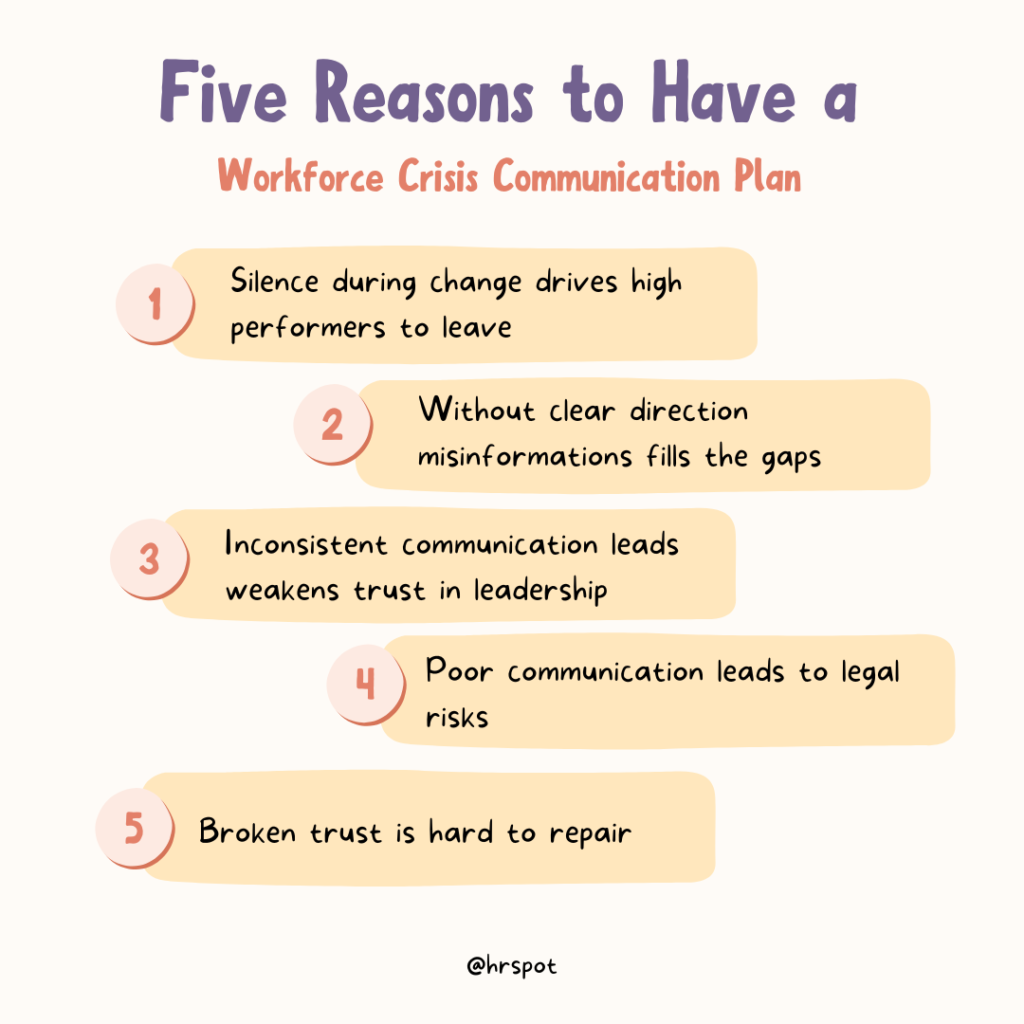
Five Reasons To Have A Workforce Crisis Communication Plan
Case Study 6:
A Charity Bank is an ethical UK-based bank that partners with organizations and individuals through finance. Their approach is to fund charities through savings deposits. Charity bank introduced a four day in week in their policies for employee wellbeing and employee retention. They used various methods to publish their policies to make their employees clear about their ideas and benefits.
Solution:
They launched a redesigned intranet and published it through newsletters.
Creating open dialogue in town hall meetings enhances organizational transparency.
Case Study 7:
In mid of 2024, an organization with 150 staff was having a toxic workplace culture, which resulted in sharp absenteeism, performance issues, formal grievance and resignations. The HR manager addressed the problems of employees and came to the conclusion that there is a clear division of mistrust between leadership and staff. Staff morale was at an all-time low. As the employee attrition rate was high, the organization was struggling to attract new talent due to the bad reputation of the workplace.
Solution:
HR conducted a full review of HR policies and practices. A six-week audit was conducted by the HR manager. The audit report suggested that communication from the management was poor and inconsistent. As a result, a six-week training program was introduced for all managers. Various initiatives were enforced, such as:
Monthly leadership circle: In this initiative, all the managers meet regularly (usually once a month) to develop skills, gain new perspectives and solve problems collaboratively.
Cultural transformation program policy: is a formal strategy that focuses on creating a positive environment, improve performance of employees, leadership commitment, ensures transparent and frequent communication about the changes.
Result: Within a year, the company made significant progress, communication improved, employees began to feel heard, and absenteeism began to decline. Managers became more confident in handling issues proactively, and staff reported feeling more supported.
Conclusion
Clear HR communication is directly proportional to employee performance. It helps the employee to maintain the positive culture by reinforcing values, integrity and maintaining stability. HR policies changes greatly impact projects and overall funding, as well as employee well-being. Transparency and adaptability to changing policies avoids poor impact on the organization.
Whenever there is any policy change, give employees advance notice.
Start by informing your team of what’s to come in a team meeting, and then follow up with a written notice. Personally speakto the staff about the changes which will help the employee to adjust to the new policy, ask for feedback and seek clarification.
Explain the policy in simple and easy language with bullet points and FAQS, provide a policy link to the employees and details when the policy is going to be implemented and impacted on them.
Explain to the employees why the policy is being made, and for what reasons it is being enforced. It makes employees more supportive of the policy change. Encourage the employees; it is in their best interest.
Before finalizing a policy, gather feedback, surveys, and one-to-one meetings to make it beneficial for everyone.
Make policies visible on the HR platform. This makes it easier for employees to reach out to the policies whenever they need them without informing the manager.