
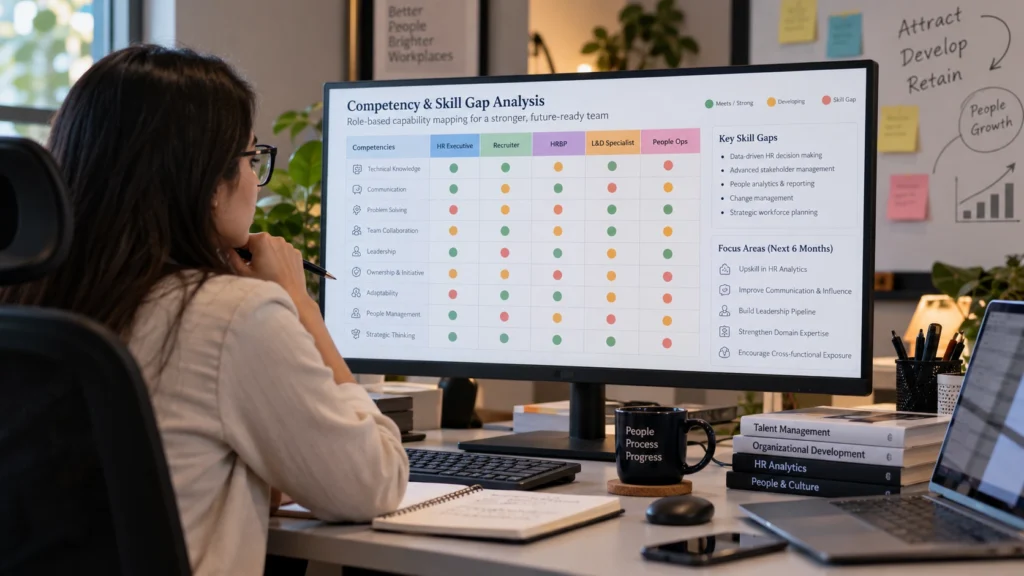
Most organisations know they have a skills problem. Far fewer can say precisely which skills are missing, in which roles, and at what level. That gap between a vague worry and a specific answer is what an HR competency model closes.
The pressure is not new, but it is intensifying. In a McKinsey survey, 87% of executives said their companies were already experiencing skill gaps or expected them within a few years. The World Economic Forum’s Future of Jobs Report 2025 puts a number on the churn: employers expect 39% of workers’ core skills to change by 2030, with AI and big data the fastest-growing skills of all.
HR is not exempt. The function that is supposed to diagnose everyone else’s skill gaps is dealing with its own, in digital fluency, analytics and strategic thinking. This article explains what HR competency models are, compares the four that matter most, and sets out a five-step framework for building one in your own organisation.
Key takeaways
- A competency model turns “we need better people” into a specific, measurable development plan.
- Four models dominate practice: Ulrich, T-shaped HR, 70-20-10 and the HR architecture model. They solve different problems and work best combined.
- AI is hollowing out the administrative expert role and raising the value of judgement, analytics and oversight.
- The four gaps showing up most in HR teams are digital, analytical, strategic and behavioural.
- A five-step design process takes a model from theory to something a manager can actually use.
What Is an HR Competency Model?
A competency model is a structured description of the knowledge, skills and behaviours a role needs in order to perform well. For HR, it answers a specific question: what must an HR professional be able to do for this organisation to meet its goals?
The idea traces back to David McClelland, who argued in 1973 that intelligence tests were poor predictors of job success and that observable competencies predicted performance far better. Spencer and Spencer later refined this, describing competencies as the underlying characteristics that separate superior performers from average ones.
This matters strategically because of the resource-based view of the firm: organisations gain lasting advantage from resources that are valuable and hard to copy. Competitors can buy your software and match your pricing. They cannot easily replicate a capable, well-developed workforce.
How the Thinking Evolved
- 1959: Robert White’s concept of effectance motivation, the human drive to master one’s environment.
- 1973: McClelland shifts assessment from IQ to measurable behaviour.
- 1982: Boyatzis widens competency to include motives and values, not just skills.
- 1990: Prahalad and Hamel introduce core competencies at the organisational level.
- Today: AI-assisted analysis identifies gaps from live workforce data rather than annual review cycles.
Four HR Competency Models Compared
| Model | Core idea | Best used for |
|---|---|---|
| Ulrich HR competency model | HR as strategic partner, change agent, administrative expert, employee champion | Defining what the HR function is for |
| T-shaped HR professional | Broad knowledge across HR plus deep expertise in one domain | Developing individual HR careers |
| 70-20-10 learning model | Learning comes mostly from experience, then relationships, then formal training | Deciding how to close a gap |
| HR architecture (three-tier) model | Different employee groups need different HR strategies | Allocating development budget |
1. The Ulrich HR Competency Model
Dave Ulrich’s model recast HR professionals as strategic contributors rather than administrators, built around four roles: strategic partner, change agent, administrative expert and employee champion. Its central claim is that HR strategy must align with business objectives to be worth anything.
For skill gap work, its value is diagnostic. Map your HR team against the four roles and the imbalance is usually obvious: most teams are strong on administrative expertise and thin on strategic partnering and change management. That is the shift strategic HR management training is designed to address.
2. The T-Shaped HR Professional Model
The T-shape describes a professional with a broad horizontal bar of knowledge across HR functions, recruitment, learning and development, performance management, compensation, and a deep vertical stem of expertise in one domain such as HR analytics.
The Academy to Innovate HR developed this into a framework whose core competencies are business acumen, data literacy, digital agility, AI fluency and people advocacy. The logic is practical: an HR specialist who understands only their own silo cannot evaluate a digital HR solution or lead a transformation project. One who has both depth and breadth can.
3. The 70-20-10 Learning Model
Lombardo and Eichinger’s model holds that roughly 70% of development comes from challenging on-the-job experience, 20% from relationships such as coaching and feedback, and 10% from formal training. The percentages come from executives’ self-reports rather than controlled research, so treat them as a reminder rather than a rule.
The reminder is a useful one. If your entire response to a skill gap is a training calendar, you are using the smallest of the three levers. We cover the practical alternatives in our guide to boosting employee development.
4. The HR Architecture (Three-Tier) Model
Lepak and Snell’s model segments the workforce by how valuable and how unique each group’s skills are, then applies a different employment and development approach to each: internal development for high-value, firm-specific talent, external contracting for work that is valuable but widely available, and so on.
For HR teams with limited budgets, this is the model that answers the uncomfortable question of where to spend first.
How AI Is Rewriting the Administrative Expert Role
The administrative expert in Ulrich’s original model handled payroll, attendance, records and compliance paperwork. Software now does most of that. Resume screening, candidate queries, leave tracking and document checks are increasingly automated.
What replaces the work is supervision of it. Someone has to check automated shortlists for bias, explain why a system reached a decision, notice when the output drifts, and decide when to override it. Predictive analytics can flag likely attrition or performance patterns, but acting on a prediction is still a human judgement with consequences for real people.
This changes what the role requires: AI literacy, data interpretation and the confidence to challenge a system’s recommendation. Those competencies belong in the model, not in a separate “future skills” document nobody reads. Building that capability is the practical work of HR analytics.
The Four Skill Gaps Showing Up in HR Teams
Digital Skill Gap
HR technology investment keeps rising, but adoption lags because teams lack confidence with HRIS platforms, digital workflows and AI-enabled tools. The result is organisations paying for systems they use at a fraction of their capability.
Analytical Skill Gap
Data-driven HR requires people who can interpret data, not just produce reports. Many HR teams can extract a dashboard but cannot say what it means for next quarter’s hiring plan. Without that interpretation step, analytics investment produces charts rather than decisions.
Strategic Skill Gap
HR is expected to contribute to business strategy and workforce planning, but the capability often hasn’t caught up with the expectation. Connecting a workforce plan to a business objective is a learnable skill, and it is the one that separates an HR manager from an HR business partner.
Behavioural and Leadership Gap
Leading change, coaching managers and holding difficult conversations are the competencies that determine whether anything on paper actually happens. They are also the ones most often assumed rather than developed.
A Five-Step Framework for Designing a Competency Model
Step 1: Identify the Competencies
Start from business goals, not from a template. What does the organisation need to achieve over the next two to three years, and what must people be able to do for that to happen? Use role analysis, interviews with high performers and benchmarking against comparable organisations. Define competencies for each role family rather than one generic list.
Step 2: Map the Gaps
Compare the competencies you need against what people currently have, using self-assessment, manager assessment and performance review data. You are looking for both the size of each gap and how urgent it is: a small gap in a critical capability outranks a large gap in something peripheral.
Step 3: Build a Digital Skill Matrix
Lay out skills against proficiency levels in a simple grid, with each role marked at the level it requires and each person at the level they have. Done honestly, this one spreadsheet shows where capability is concentrated in a single person, which is a risk, and where it is missing entirely.
Step 4: Anchor Ratings in Behaviour
Behaviourally Anchored Rating Scales replace abstract ratings with descriptions of what each level looks like in practice. Instead of rating communication 3 out of 5, a manager matches the person against a described behaviour. This cuts subjectivity, sets clear expectations and makes feedback conversations concrete.
Step 5: Develop and Implement
Design interventions that match the gap. Use the 70-20-10 split deliberately: a stretch assignment for experience, a mentor for the relationship element, a course or certification for the formal component. Then set a review date. A competency model that isn’t revisited becomes a document rather than a tool.
Implementation Challenges to Expect
- Size and readiness: frameworks designed for large corporates often collapse in a 60-person company. Start with two or three role families rather than the whole organisation.
- Assessment honesty: if ratings feed directly into increments, people rate strategically. Separate development assessment from pay decisions, at least initially.
- Manager capability: the model is only as good as the managers applying it, which usually means training them first.
- AI ethics and data privacy: competency data is personal data. Decide who can see it, how long it is kept and what an algorithmic recommendation may and may not decide on its own.
- Going stale: with a meaningful share of core skills changing by 2030, a model written once and filed away will misdirect development spending within a couple of years.
Frequently Asked Questions
What is an HR competency model?
A structured description of the knowledge, skills and behaviours an HR role requires, used to assess current capability, identify gaps and plan development against business goals.
What is the difference between a competency model and a job description?
A job description lists duties and responsibilities. A competency model describes the capabilities and behaviours needed to perform those duties well, at defined proficiency levels, which is what makes it usable for assessment and development.
Which HR competency model should we use?
They answer different questions, so most organisations combine them: Ulrich to define what the HR function should deliver, the T-shaped model for individual development, the HR architecture model to prioritise spending, and 70-20-10 to decide how to close each gap.
What skills do HR professionals need most right now?
Data literacy and analytics, AI fluency with the judgement to oversee automated decisions, business acumen to connect HR work to commercial goals, and the behavioural skills to lead change.
How often should a competency framework be updated?
Review it annually and rebuild it every two to three years, or sooner after a significant change in technology, strategy or structure.
Conclusion
HR competency models are not an academic exercise. They are the mechanism that converts a general anxiety about skills into a specific, fundable development plan, and they decide whether HR enters the strategy conversation with evidence or with opinions.
The established models, Ulrich, T-shaped, 70-20-10 and HR architecture, remain sound. What has changed is the content of the competencies themselves: AI has removed much of the administrative work that once defined HR and raised the premium on analysis, judgement and oversight. The organisations that update their frameworks to reflect that, and keep updating them, will be the ones whose HR teams stay relevant.
Build These Competencies in Practice
Competency mapping, analytics and strategic workforce planning are learned by doing them on real cases. HR Spot’s Strategic Diploma in Human Resource Management covers competency frameworks and workforce strategy, while the HR Generalist course builds the functional breadth the T-shaped model calls for. Not sure which level fits? Use the HR course finder or talk to a counsellor.
References
- Barney, J. (1991). Firm resources and sustained competitive advantage. Journal of Management, 17(1), 99–120.
- Boyatzis, R. E. (1982). The Competent Manager: A Model for Effective Performance. John Wiley & Sons.
- Lepak, D. P., & Snell, S. A. (1999). The human resource architecture. Academy of Management Review, 24(1), 31–48.
- Lombardo, M. M., & Eichinger, R. W. (1996). The Career Architect Development Planner. Lominger Limited.
- McClelland, D. C. (1973). Testing for competence rather than intelligence. American Psychologist, 28(1), 1–14.
- McKinsey & Company (2020). Beyond hiring: How companies are reskilling to address talent gaps.
- Prahalad, C. K., & Hamel, G. (1990). The core competence of the corporation. Harvard Business Review, 68(3), 79–91.
- Spencer, L. M., & Spencer, S. M. (1993). Competence at Work: Models for Superior Performance. John Wiley & Sons.
- Ulrich, D. (1996). Human Resource Champions. Harvard Business School Press.
- Ulrich, D., Brockbank, W., Yeung, A., & Lake, D. (1995). Human resource competencies. Human Resource Management, 34(4), 473–495.
- World Economic Forum (2025). Future of Jobs Report 2025.